Autism and Accessing Creative Writing
Late diagnosis for me meant being assessed as autistic at the grand old age of 56. For me this was a positive diagnosis once I navigated my way through the initial 12 – 18 months of reflection, research and discussion within a local self-help group. I felt as though I understood myself better and that included why I hadn’t done things that I wanted to over the years such as singing and writing. One of my major barriers was joining and participating in groups and whilst you can sing and write by yourself, joining choirs and local writing groups can bring benefits. Except, I didn’t know how to access these spaces.
Up steps someone I worked with who also ran a community choir. When I expressed interest, they invited me along and helped me feel welcome on my first visit. Aha! I thought, if I can do that… I use my logical brain to find ways to join a writing group and so I did. Within a year, I was in three choirs and five writing groups, performing and applying for paid writing residencies. Towards the end of one writing residency, I was filling in my arts council paperwork in the Writing East Midlands (WEM) office when the Chief Executive came in and asked how things were going.
“Really good,” I responded but why are there so few opportunities focused on disabled people who surely can benefit from creative writing too. “Fair comment,” says he, quickly coming back with a challenge: “So how would that work then?” And that’s how something that was eventually called Beyond the Spectrum was hatched. WEM recognised the potential of the idea, accessed some small-scale funding and by 2020 we had two groups for adults and two for children, accessed online only due to covid . You can find more details of the project here: https://beyondthespectrum.uk/
How does it work? Each group has two paid facilitators, a Lead and supporting ‘Shadow’ Facilitator one of whom must be autistic. Each group has up to 12 autistic participants and places are free. Sessions were initially fortnightly with facilitators providing ideas for writing exercises for people to try out during the session with anyone who wanted to share their work welcome to do so; either by reading it to the group, asking one of the facilitators to read it or posting it in the chat function. No one had to share if they didn’t want to and having your camera on and speaking were optional.
The quality of the writing quickly proved to be high and the feedback from participants much more positive than we expected. My favourite was someone from the under 18s group who said, ‘Before BtS I had lots of things whirling about my head but now I have somewhere to put them’. WEM slowly accessed further small funding pots to keep the original groups going, gradually introducing new groups with a couple of anthologies of participants' work being published followed by performances of individual’s works at local libraries. In 2023, following an evaluation of the initial project by Nottingham Trent University, we were awarded £460,000 from three sources to expand the project across other regions.
So we are now coming to the end of our second project year and for me, it’s hard to believe what we've achieved since that first grumble of a conversation about the lack of creative writing opportunities for autistic people.
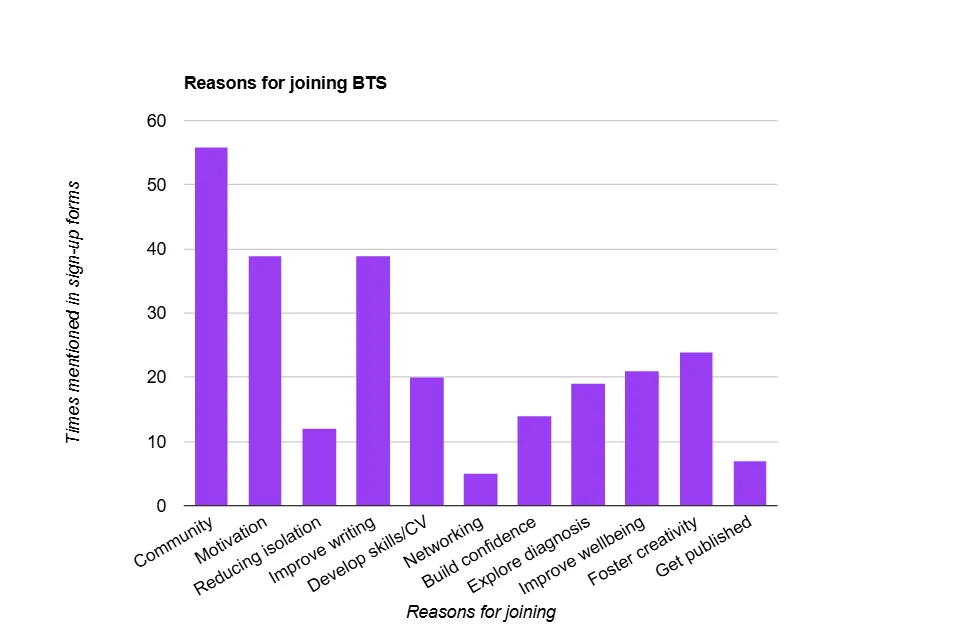
There have been 307 workshops delivered since 2020 and 11 collections of the work of participants published. Some autistic ‘Shadow Facilitators’ have gone on to become Lead Facilitators, some participants have joined other mainstream writing groups and others have become published in various forums. Individuals' reasons for joining are varied, as shown in this table, and whilst people are interested in many different genres of writing, poetry is the area with the most interest with fiction and sci-fi / fantasy also popular.
We currently have 13 adult groups and 3 children’s groups with a total of 191 individuals participating of all ages from over 40 postcodes within England. Interestingly, much like autism itself, it’s difficult to define a group participant profile. If we need more participation from any sections of neurodivergent communities I would say that we have an under representation by learning disability, non-speaking and global majority individuals and we aim to address that in the remaining half of the three-year project.
Whilst the statistics to date are very encouraging, it’s the quality of the writing and the consistent feedback from participants and their families that I find the most heart warming. For example:
"It was my little time out away from everything inside my head and with people like me. It is my first real experience of being with other autistic adults and it was just so special. So validating. And to have so many people praise what I had written was the best boost during each session. I saw myself grow from the beginning of thinking my writing will never be as good as the other participants to by the end actually being really proud of what I had produced and all the praise from the facilitators and participants definitely helped that."
"I saw another side to my child tonight. She is usually guarded when sharing ideas and completes minimal work with lots of encouragement. She went to bed very happy after a tough day."
"I am still in complete shock but also really excited at the same time as this would be my first ever time getting published thank you so much for making my dream come true."
Such feedback has been consistent across the groups and years, and we are now looking forward to further development in our third year with a view to securing longer term continuation funding from 2027. We run a couple of showcase events and specialist workshops each year and copies of the BtS Anthologies are available for free download from the website. If you or anyone you know are interested in becoming a participant or group facilitator then get in touch by using the simple form on the website page. Finally, if your organisation is interested in partnering with us by helping us expand in your area and supporting future funding bids then please also get in touch for a no commitment exploratory conversation.
Trevor Wright FRSA January 2026